 Listicle
Professional Lighting Design Services: Benefits Explained
Table of Contents
- What Professional Lighting Design Delivers
- Energy Efficient Lighting Solutions That Lower Your Bills
- How Lighting Design Improves Mood and Well-Being
- Lighting Design for Kitchen Remodeling Projects
- Safety, Security, and Functional Task Lighting
- Hiring a Licensed Electrician for Lighting Installation
- Why Professional Design Adds Real Property Value
- Conclusion
- Frequently Asked Questions
Last Updated: September 25, 2026
What Professional Lighting Design Delivers
Professional lighting design transforms how spaces function and feel. It's not just about brightness, it's about creating the right light in the right place at the right time. Curtis Capra Electrician has spent over 25 years helping homeowners and businesses understand that quality lighting design is a strategic investment, not an afterthought.
When you work with a professional lighting designer, you get three things most DIY approaches miss: a comprehensive plan that integrates with your architecture, fixture placement that eliminates glare and shadows, and control systems that adapt to how you actually use the space. The difference between amateur lighting and professional design shows up immediately in comfort, functionality, and aesthetics.
This guide covers what professional lighting design actually delivers and why it matters for your property value, energy bills, and daily quality of life.
Energy Efficient Lighting Solutions That Lower Your Bills
Energy consumption is often the first concern homeowners raise, and rightfully so. Professional lighting design reduces energy use by matching fixture type and wattage to actual task requirements rather than over-lighting entire rooms. But the real value emerges when you calculate the return on your design investment against monthly savings.
Understanding Your Energy Baseline
Professional design identifies inefficiencies and redirects spending into fixtures and controls that serve your actual needs.
A well-designed system uses LED fixtures with appropriate lumens for each area. Task lighting concentrates illumination where work happens, kitchen countertops, bathroom vanities, reading areas. Ambient lighting provides general visibility at lower wattage. Accent lighting highlights architectural features without consuming power for function. This layered approach cuts energy consumption compared to a single bright fixture running all the time.
Calculating Your ROI
Professional lighting design and installation can reduce your annual lighting energy use, leading to savings over time. The real return compounds when you factor in increased home value and the comfort gains that make the space more livable from day one.
Dimming controls extend efficiency further. Many spaces don't need full brightness throughout the day. Dimmable LED fixtures let you adjust lighting levels to match actual needs, reducing wattage draw during off-peak hours or when natural daylight supplements artificial light. Occupancy sensors in utility areas, bathrooms, and storage spaces eliminate the waste of lights left running in unoccupied rooms.
Integration During Renovation Saves More
Curtis Capra Electrician works with homeowners to design lighting layouts that meet task requirements without excess. The critical advantage of planning lighting during renovation, rather than retrofitting later, is that circuit routing and fixture placement can be optimized before walls close. This eliminates the need for expensive conduit runs through finished surfaces and allows electricians to position wiring for maximum efficiency. The result is lower monthly bills, reduced strain on electrical panels during peak usage times, and more efficient installation compared to retrofitting the same design into a finished home.
When lighting is planned as part of your architectural blueprint on Cape Cod or anywhere else, electricians can coordinate with HVAC and plumbing rough-ins to avoid conflicts and reduce labor time. This integrated approach is why professional design paired with licensed installation delivers measurable savings that DIY approaches cannot match.
How Lighting Design Improves Mood and Well-Being
Light affects your body's circadian rhythm, the internal clock that regulates sleep, alertness, and hormone production (Good Places to Live and Sleep Well). Professional lighting design accounts for this through color temperature and timing strategies.
Warmer color temperatures (2700K-3000K) promote relaxation and are ideal for bedrooms, living rooms, and dining areas. Cooler color temperatures (4000K-5000K) enhance alertness and focus, making them better for kitchens, offices, and workspaces. Human-centric design uses these principles to support your natural rhythms throughout the day.
Glare reduction improves comfort dramatically. Poorly positioned fixtures create glare that causes eye strain, headaches, and fatigue. Professional designers position fixtures to avoid direct sight lines and use diffusers or indirect lighting techniques to soften harsh light. The result is visual comfort that lets you relax or work without discomfort.
Adequate lighting levels prevent the depression and fatigue that come from dim, shadowy spaces. Insufficient illumination forces your eyes to work harder and creates psychological heaviness. Properly lit spaces feel open, inviting, and energizing.
Lighting Design for Kitchen Remodeling Projects
Kitchen lighting is one of the most complex design challenges because kitchens demand multiple lighting types simultaneously. Task lighting must illuminate countertops and cooking surfaces without casting shadows. Ambient lighting needs to fill the space evenly. Accent lighting can highlight finishes or architectural features.
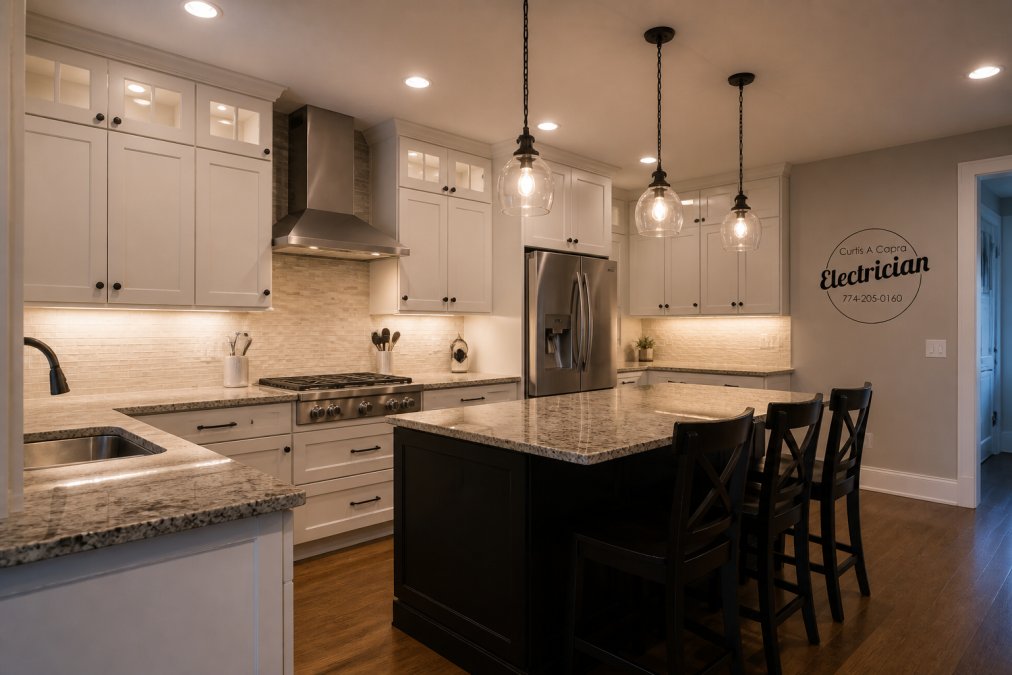
A professional designer creates a fixture layout that supports food preparation, dining, and socializing in the same room. Under-cabinet lighting eliminates shadows on work surfaces. Recessed ceiling fixtures provide general illumination without visual clutter. Pendant lights over islands add task lighting and aesthetic appeal. Dimming controls let you adjust the mood for cooking versus entertaining.
When Curtis Capra Electrician plans kitchen lighting during renovation, we integrate the electrical infrastructure into your architectural plans before cabinets and countertops go in. This prevents costly rewiring later and ensures circuits are positioned for optimal fixture placement. The design accounts for your cabinet layout, countertop materials, and how you actually use the space.
Color temperature matters in kitchens too. Neutral white (3500K-4100K) is ideal because it doesn't distort food colors the way warm or cool light can. Your designer will specify fixture color temperature to match your aesthetic while maintaining accurate color perception for cooking.
Safety, Security, and Functional Task Lighting
Proper illumination prevents accidents. Stairways, entryways, and transitions between rooms need adequate lighting to prevent trips and falls. Functional task lighting in bathrooms, laundries, and utility areas ensures you can see what you're doing safely.
Security lighting around exterior entrances deters unwanted access and helps you see who's approaching your property. Motion-activated fixtures provide security without consuming energy all night. Pathway lighting guides safe movement around your property.
Professional designers specify fixture brightness (lumens), placement, and control to meet safety standards. This is especially important in aging-in-place designs where adequate lighting prevents falls and maintains independence.
Hiring a Licensed Electrician for Lighting Installation
Not all electricians understand lighting design. The electrical installation must match the designer's specifications exactly, fixture type, circuit routing, dimmer compatibility, and control system integration all matter.
A licensed electrician like Curtis Capra Electrician brings two critical skills: understanding electrical codes and safety standards, and experience integrating lighting systems with your home's overall electrical infrastructure. We hold license #57632B and participate in Mass Save programs that support energy-efficient upgrades.
When you hire an electrician for lighting installation, verify they're licensed and insured. Ask about their experience with dimming controls and smart lighting systems if those are part of your design. Confirm they'll pull permits and have work inspected, this protects you and ensures the installation meets code.
The electrician's role includes running circuits to support the designer's fixture placement, installing appropriate breakers and wiring, and testing controls before final activation. This coordination between designer and electrician is what separates professional results from amateur installations.
Why Professional Design Adds Real Property Value
Buyers notice quality lighting immediately, but the value isn't just aesthetic, it's structural. Professional lighting design demonstrates that electrical infrastructure was planned thoughtfully and integrated with the home's architecture, which appraisers and inspectors recognize as a mark of quality work throughout the property.
How Appraisers Evaluate Lighting Design
During a home appraisal, lighting quality factors into the overall condition and functionality assessment.
Integration with Architectural Features Increases Perceived Value
Energy Efficiency as a Measurable Asset
Timing Matters: Design During Renovation, Not After
Conclusion
Professional lighting design delivers benefits across energy efficiency, health and well-being, functionality, and property value. It's an investment that pays dividends through lower utility bills, improved comfort, and enhanced aesthetics.
Frequently Asked Questions
Why is professional lighting design important for my home?
Professional lighting design balances aesthetics, function, and energy efficiency in ways that DIY approaches often miss. A designer evaluates your room's spatial perception, natural light sources, and how you actually use each space. This prevents costly mistakes like over-lighting (wasted energy), under-lighting (eye strain), and poor fixture placement. The result is a lighting layout that's both beautiful and practical, improving safety, mood, and your home's overall appeal.
How much can energy efficient lighting solutions save me annually?
LED fixtures use 75% less energy than incandescent bulbs and last 25 times longer, reducing both consumption and maintenance costs. A professional lighting design optimizes fixture placement and dimming controls to prevent over-lighting, which wastes significant energy. Exact savings depend on your current setup, home size, and usage patterns. Curtis Capra Electrician, serving Cape Cod, can assess your current system and provide a detailed estimate of potential savings during a consultation.
What should I look for when hiring a licensed electrician for lighting work?
Verify they hold a current state license and proof of insurance before any work begins. Ask about their experience with lighting design specifically, not just general electrical work. A qualified professional understands fixture placement, color temperature selection, and how to integrate smart lighting systems. They should also be familiar with local electrical codes and safety standards. Curtis Capra Electrician holds LIC#57632B and brings over 25 years of experience to every project on Cape Cod.
Can professional lighting design really increase my home's resale value?
Yes. Well-designed lighting is a visible, functional upgrade that buyers notice immediately. Professional design demonstrates attention to detail and quality, which suggests proper electrical installation and safety compliance. Layered lighting (ambient, task, and accent) makes spaces feel larger and more sophisticated. Potential buyers associate professional lighting with higher-end homes, and this perception translates to appraisal value. The investment in design often returns more than its cost at resale.