 how-to
Heat Pump Electrical Requirements for Homes: 2026 Guide
Table of Contents
- Understanding Heat Pump Electrical Requirements for Homes
- Why Heat Pumps Need a Dedicated Circuit
- Voltage, Amperage, and Wiring: What Your System Needs
- Heat Pump Circuit Breaker Size and Wire Gauge Reference
- Does Your Electrical Panel Have Enough Capacity?
- Electrical Panel Upgrade Cost: What to Expect
- How to Choose a Licensed Electrician for Panel Replacement
- Smart Panels, Sub-Panels, and Inverter Heat Pumps
- Conclusion
- Frequently Asked Questions
Last Updated: September 18, 2026
Understanding Heat Pump Electrical Requirements for Homes
Heat pump electrical requirements for homes start with one hard truth: these systems need their own power supply. A heat pump cannot share a circuit with your outlets, lights, or kitchen appliances. It needs a dedicated circuit sized to its exact electrical load and nameplate rating. At Curtis Capra Electrician, we've wired heat pumps across Cape Cod for years, and the same mistake shows up again and again: homeowners buy the unit first, then discover their panel can't carry it.
Why Heat Pumps Need a Dedicated Circuit
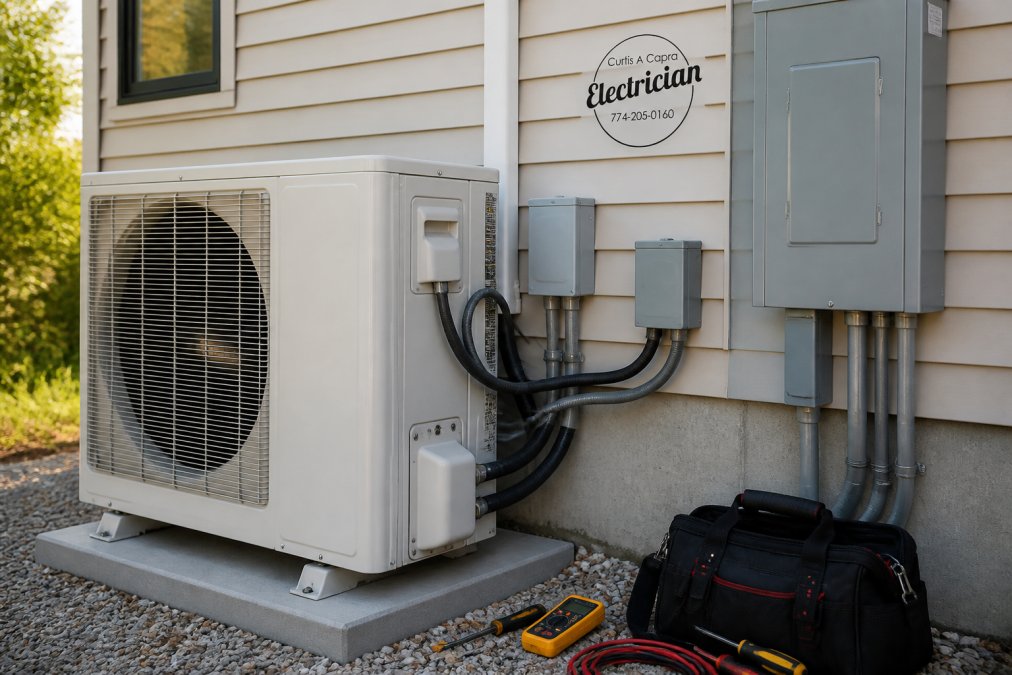
A dedicated circuit is a single breaker that serves one appliance and nothing else. Heat pumps require one because they pull a heavy, steady load that spikes hard when the compressor starts.
- The circuit must be sized to the unit's rated load, not your best guess
- No other outlets or lights can share that breaker
- The breaker must match the wire gauge, not just the unit
Voltage, Amperage, and Wiring: What Your System Needs
Most residential heat pumps run on 240-volt power, though some smaller units use 208-volt service in multi-unit buildings. That higher voltage lets the system run efficiently without pulling dangerous current. Amperage ratings typically fall between 20A and 60A, depending on system size and whether you have a standard or inverter-driven unit.
Reading the Nameplate: MCA and MOP Explained
Two numbers on the nameplate decide everything: MCA (Minimum Circuit Ampacity), the smallest circuit the unit can safely run on, and MOP (Maximum Overcurrent Protection), the largest breaker you're allowed to install. Here's what most guides miss: you size the wire to the MCA, but the breaker to the MOP. Get this backwards and you either trip constantly or leave the wire undersized.
Heat Pump Circuit Breaker Size and Wire Gauge Reference
Breaker size and wire gauge must match. A bigger breaker on thin wire is a fire waiting to happen. Use this reference as a starting point, then confirm against your unit's nameplate and local code.
| System Size | Typical Breaker | Wire Gauge (Copper) | Notes |
|---|---|---|---|
| Small (up to 24K BTU) | 20A-30A | 10-8 AWG | Often single-zone mini-split |
| Mid-size (24K-36K BTU) | 30A-40A | 8 AWG | Common whole-home unit |
| Large (36K-48K BTU) | 40A-50A | 8-6 AWG | May need sub-panel |
| Extra-large (48K+ BTU) | 50A-60A | 6 AWG | Often needs service upgrade |
Does Your Electrical Panel Have Enough Capacity?
Your panel has enough capacity if it can carry the heat pump's load plus everything already running in your home. Most older Cape Cod homes were built with 100-amp service, and that fills up fast once you add a heat pump, an electric range, and a dryer.
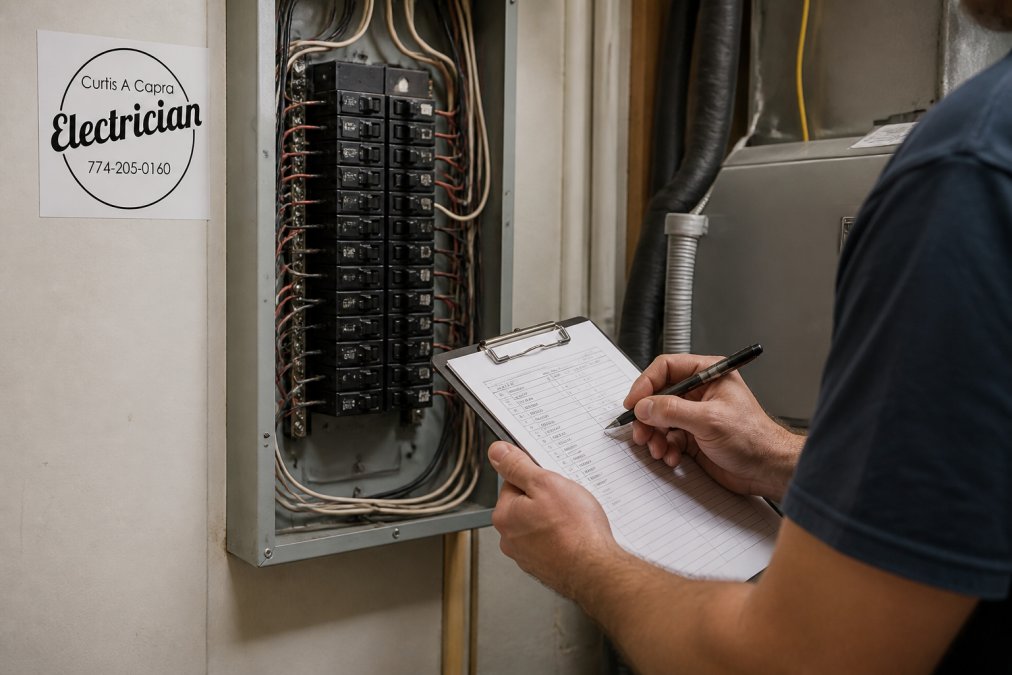
Signs your panel needs an upgrade:
- No open slots for a new double-pole breaker
- A 100-amp service feeding a modern, all-electric home
- Fuses instead of breakers
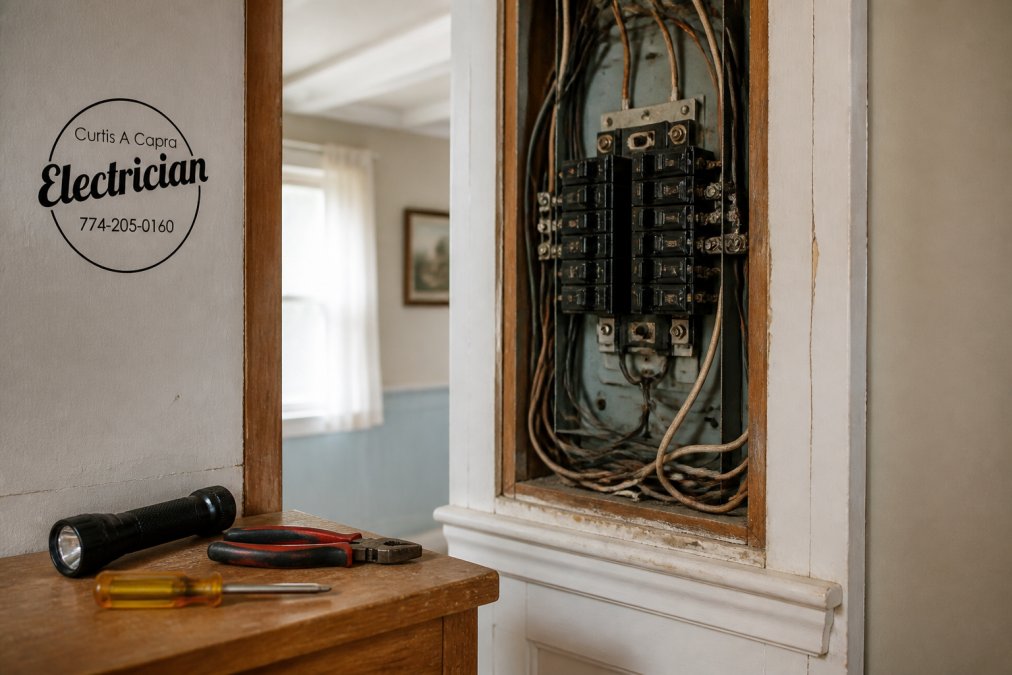
- Rust, scorch marks, or a burning smell near the panel
- Breakers that trip when the heat pump starts
The 80% Rule and Load Calculations
The 80% rule says a breaker should carry no more than 80% of its rating continuously, so a 40A breaker handles a 32A continuous load, max. A proper load calculation follows the NEC method: it totals your general lighting load, adds fixed appliances, and applies demand factors to avoid double-counting. This is the step most homeowners skip, and it decides whether you need a service upgrade. Here's how it works:
- General lighting and receptacles: Multiply square footage by 3 VA per square foot. A 2,000 sq ft home = 6,000 VA.
- Small appliance and laundry circuits: Add 1,500 VA for each kitchen circuit and 1,500 VA for laundry. A typical home has two kitchen circuits plus laundry = 4,500 VA.
- Fixed appliances: Add the nameplate rating of every permanently installed appliance, water heater, range, dryer, dishwasher, disposal, and the heat pump itself.
- Apply demand factors: The first 3,000 VA of lighting and small appliance load counts at 100%. The remainder counts at 35%. For appliances, the largest motor adds 25% to its rating.
- Convert to amps: Divide total VA by 240V to get the service load in amps.
Sub-Panel vs. Service Upgrade: Which Do You Need?
When your main panel is full or your calculated load exceeds capacity, you have two paths. The right choice depends on how close you are to your service limit and what else you plan to add.
A sub-panel makes sense when:
- Your main service has capacity, but the breaker spaces are full
- You need two to six additional circuits for the heat pump and related equipment
- The run from the main panel to the sub-panel location is practical
- You're not planning major new loads like an EV charger or a second heat pump
A service upgrade makes sense when:
- Your calculated load exceeds 80% of your service rating
- You have a 100A service and an all-electric home
- You're adding an EV charger, a second heat pump, or a large addition
- Your existing panel is a known problematic brand or shows signs of failure
Electrical Panel Upgrade Cost: What to Expect
Electrical panel upgrade cost depends on several factors, so there's no single number that fits every home. Pricing varies by panel size, service amperage, permit requirements, and the condition of your existing wiring. Because every home is different, the honest answer is to get a written quote after an on-site assessment. Curtis Capra Electrician provides free quotes for panel work across Cape Cod, so you know the real number before any work begins.
What drives the cost up or down:
- Whether you move from 100-amp to 200-amp service
- Whether the meter or service mast needs replacement
- Permit and inspection fees in your area
- Whether a sub-panel is a simpler alternative
How to Choose a Licensed Electrician for Panel Replacement
Choosing a licensed electrician for panel replacement comes down to three checks: verify the license, confirm insurance, and get the scope in writing. Anything less leaves you holding the liability.
Use this checklist before you hire:
- Ask for the license number and verify it with your state board
- Request a certificate of insurance for both liability and workers' comp
- Get a written scope that names the panel size and amperage
- Confirm who pulls the permit and who handles the inspection
- Ask how they handle grounding and bonding on your service
- Get the timeline in writing, especially for renovation projects
A real professional welcomes these questions.
Smart Panels, Sub-Panels, and Inverter Heat Pumps
Two upgrades solve most capacity problems without a full service change. A sub-panel adds breaker space for the heat pump circuit alone, often cheaper than replacing the main panel. A smart panel goes further: it monitors each circuit and sheds loads automatically, so your heat pump and EV charger don't fight for power.
How Smart Panels Work with Heat Pumps
A smart panel replaces your standard breaker panel with one that has current transformers on each circuit. These sensors report real-time amperage draw to a mobile app, and the controller can automatically trip or throttle specific circuits when total demand approaches your service limit. For example: your heat pump runs at 25A, your EV charger kicks on at 32A, and your dryer starts at 24A, 81A on a 100A service.
Inverter Heat Pumps and Startup Current
Traditional heat pumps draw a big startup surge, called inrush current, every time the compressor kicks on, 3 to 5 times the running current, so a 30A unit might briefly pull 90A or more. That spike forces electricians to size breakers and wire for the worst-case moment, not the steady-state load. Inverter-driven heat pumps eliminate that surge by ramping the compressor up gradually, drawing only what the system needs.
Matching the Right Solution to Your Home
For older Cape Cod homes with tight panel capacity, combining a smart panel and an inverter heat pump is often the smartest path. The inverter reduces the load, and the smart panel manages what's left, together deferring or eliminating a service upgrade. A sub-panel remains the simpler choice when you just need breaker space and your service has capacity to spare.
Conclusion
The hardest part of a heat pump install isn't the unit. It's making sure your home's electrical system can actually carry it safely.
Frequently Asked Questions
Can you run a heat pump on a 100-amp service?
Often, yes, but it depends on your home's total electrical load. A 100-amp service can handle a single heat pump if the rest of your home's demand is low. However, adding a heat pump to an already loaded panel may require an upgrade. A load calculation performed by a licensed electrician like Curtis Capra Electrician will confirm whether your existing service is sufficient.
What size heat pump is needed for a 2000 sq ft house?
For a 2000 sq ft home in a climate like Cape Cod, a 3-ton (36,000 BTU) heat pump is common, though insulation, window efficiency, and ductwork affect the final size. The electrical requirements scale with tonnage: a 3-ton system typically needs a 30 to 40 amp dedicated circuit. A professional load calculation and Manual J assessment determine the exact size.
Do I need a 200-amp panel upgrade to install a heat pump?
Not always. Many homes with 200-amp service can add a heat pump without an upgrade. Homes with 100-amp service may need an upgrade if the panel is already near capacity or if you are adding other large loads. An electrician will check your panel's amperage rating, available breaker spaces, and total load before recommending an upgrade.
What is the 80% rule for electrical circuits and heat pumps?
The 80% rule means a continuous load should not exceed 80% of a circuit's breaker rating. For heat pumps, the minimum circuit ampacity (MCA) on the nameplate already accounts for this. For example, a heat pump with an MCA of 24 amps requires at least a 30-amp breaker. Following this rule prevents nuisance tripping and overheating.