 how-to
Electrical Wiring Safety for Older Homes: 2026 Guide
Table of Contents
- How to Spot the Signs of Faulty Electrical Wiring
- Electrical Wiring Safety for Older Homes: The Main Hazards
- Your Step-by-Step Electrical Inspection Checklist for Older Homes
- GFCI Outlet Installation Requirements Every Homeowner Should Know
- Partial Rewiring vs. Full Rewiring: What Makes Sense for Your Home
- How Wiring Safety Affects Insurance, Resale Value, and Smart Home Upgrades
- When to Call Curtis Capra Electrician for Wiring Safety on Cape Cod
- Frequently Asked Questions
Last Updated: September 16, 2026
How to Spot the Signs of Faulty Electrical Wiring
Electrical wiring safety for older homes starts with knowing what trouble looks like before it becomes a fire. At Curtis Capra Electrician, we've spent over 25 years walking through houses where the warning signs were visible for years before anyone acted on them.
Faulty electrical wiring is any wiring that can no longer safely carry current to your outlets and fixtures, whether because of degraded insulation, loose connections, or materials that were never designed for modern electrical loads. The signs of faulty electrical wiring tend to show up in clusters, not one at a time:
- Flickering lights when appliances cycle on
- Switch plates or outlet covers that feel warm to the touch
- A faint burning smell near outlets or the panel
- Breakers that trip repeatedly, even with normal usage
- Two-prong outlets with no ground path
One warning sign on its own is easy to dismiss. Three or more together usually means the system needs professional evaluation, not another trip to the hardware store.
Electrical Wiring Safety for Older Homes: The Main Hazards
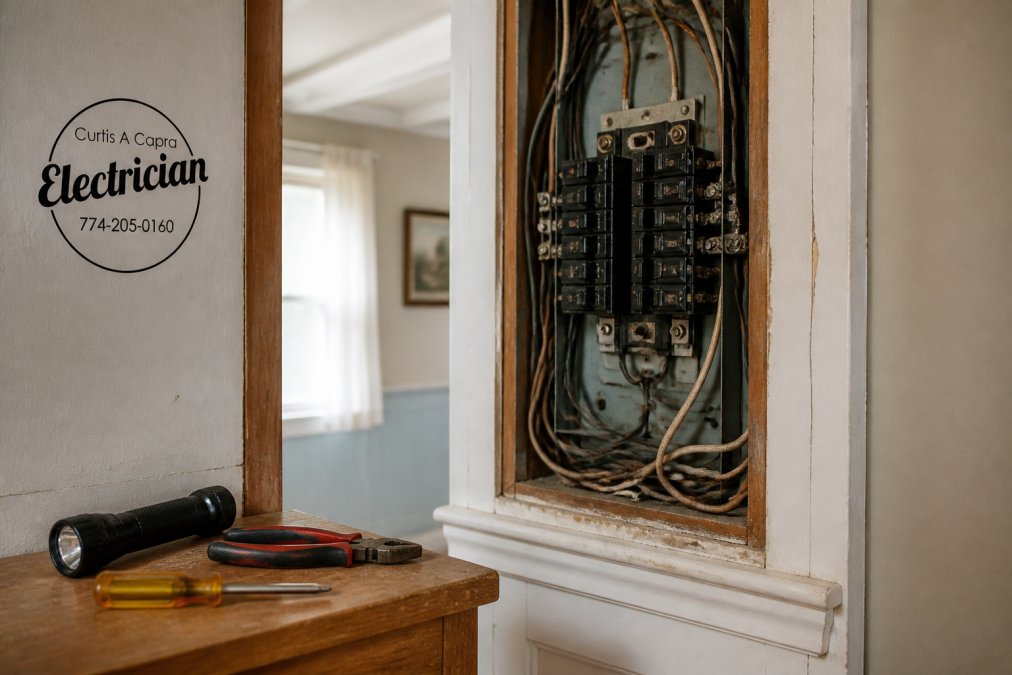
The hazards in older homes trace back to materials that were standard decades ago and are now known failure points. Knob-and-tube wiring, common in homes built before the 1950s, runs individual conductors through ceramic knobs with no ground conductor at all. The insulation on that wiring becomes brittle with age, and it was never rated for the amperage modern appliances draw.
Aluminum wiring, used heavily in the 1960s and 1970s, expands and contracts differently than copper at connection points. Over time those connections loosen, which creates resistance, which creates heat.
Overloaded circuits are the third major hazard, and the most preventable. Older homes often have far fewer circuits than modern code requires, so a single breaker may carry a bedroom, a hallway, and a home office at once. Add a space heater and the circuit is past its limit.
The NFPA electrical fire statistics consistently rank electrical distribution and lighting equipment among the leading causes of home structure fires. That's the case for treating these hazards as maintenance items, not someday projects.
Your Step-by-Step Electrical Inspection Checklist for Older Homes
An electrical inspection checklist for older homes helps you document what you find and hand a clear picture to a licensed electrician. Work through it room by room, and stop immediately if you smell burning or see scorch marks.
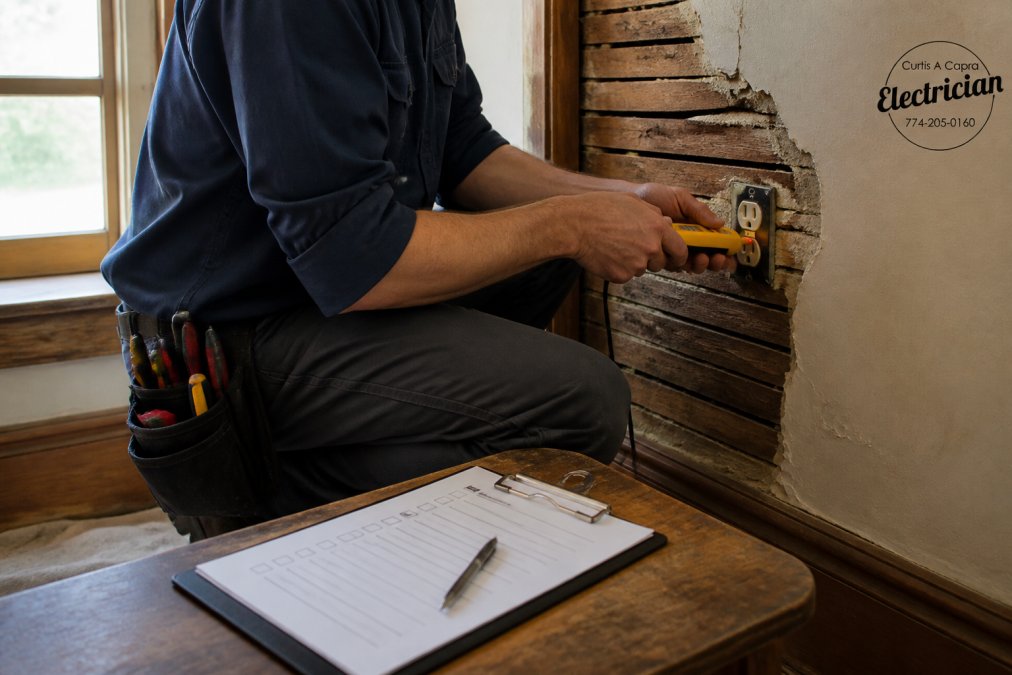
- Check every outlet for warmth, discoloration, or a loose fit when you plug something in.
- Test each GFCI outlet using its test and reset buttons.
- Note every two-prong outlet and every ungrounded three-prong conversion.
- Flip each light switch and listen for crackling or buzzing.
- Open the panel cover only if you're comfortable doing so, and look for rust, scorch marks, or double-tapped breakers.
- Record how many outlets share each circuit by tripping breakers one at a time.
- Check the attic and basement for exposed knob-and-tube or spliced aluminum wiring.
The U.S. Consumer Product Safety Commission home electrical safety guidance recommends treating any home with knob-and-tube or aluminum wiring as a candidate for professional evaluation, since neither material can be made safe through cosmetic fixes.
GFCI Outlet Installation Requirements Every Homeowner Should Know
A GFCI (Ground Fault Circuit Interrupter) outlet is a device that cuts power within a fraction of a second when it detects current leaking to ground, protecting people from electrical shock. GFCI outlet installation requirements apply to kitchens, bathrooms, garages, basements, laundry areas, and any outdoor outlet, per the National Electrical Code requirements.
Older homes frequently have zero GFCI protection because the technology didn't exist when they were wired. Retrofitting is one of the highest-value safety upgrades available, and it doesn't require a full rewire. A GFCI can protect downstream outlets on the same circuit when wired correctly, which means one device can cover an entire kitchen counter run.
| Location | GFCI Required | Why It Matters |
|---|---|---|
| Bathrooms | Yes | Water contact near outlets |
| Kitchen counters | Yes | Appliances plus water |
| Garage and basement | Yes | Damp concrete, tools |
| Outdoors | Yes | Rain and irrigation exposure |
| Bedrooms | No (AFCI instead) | Arc fault protection |
AFCI (Arc Fault Circuit Interrupter) breakers cover a different risk: arcs inside damaged wiring. Many older panels can't accept AFCI breakers without an upgrade, which is one reason panel modernization comes up so often during inspections.
Partial Rewiring vs. Full Rewiring: What Makes Sense for Your Home
Partial rewiring replaces the circuits that are actively failing or that serve high-demand areas, while full rewiring replaces the entire system. The right choice depends on how much of the original wiring remains, whether it's reachable, and what you plan to do with the house.
A cost-benefit analysis of partial versus full rewiring usually comes down to four questions:
- How much original wiring is left? A single failed circuit in an otherwise updated home is a partial job. A home where most branch circuits are still knob-and-tube or aluminum is a different conversation.
- Is the panel modern enough to support new circuits? If the panel can't accept AFCI or GFCI breakers, adding circuits without addressing the panel just moves the bottleneck.
- Are the walls already open? This is the single biggest cost lever. Rewiring behind finished lath and plaster means opening and patching; rewiring during a renovation means the access work is already happening.
- How long do you plan to stay? A partial fix that gets you through the next few years is a different decision than a full modernization you'll never recoup before selling.
Where partial rewiring wins: one failing circuit, one high-demand area (kitchen, laundry, home office), or a finished home where the disruption of a full rewire isn't justified by the remaining risk. It solves the immediate problem with the least wall-opening and the shortest downtime.
Where full rewiring wins: substantial knob-and-tube or aluminum remaining, a panel that can't be modernized incrementally, or a renovation that's already exposing the framing.
If you're not sure which side of that line your home falls on, Curtis Capra Electrician can walk the property and give you a straight answer before you commit to either path.
How Wiring Safety Affects Insurance, Resale Value, and Smart Home Upgrades
Wiring safety affects three things most homeowners don't think about until they're already in a transaction: insurance underwriting, resale negotiations, and whether smart home devices will actually work.
- Neutral wire requirement. Many smart switches and dimmers need a neutral wire at the switch box to power their radios. Older switch loops often have no neutral, which means either a different device or a new cable run.
- Grounding. Ungrounded circuits can cause flickering, buzzing, or unreliable behavior in sensitive electronics. A panel-mounted surge protector helps, but it can't compensate for a missing ground path.
- Load and circuit count. Older homes often have fewer circuits than modern code requires, so adding high-draw smart appliances (a smart dryer, a tankless water heater controller, an EV charger) can push a circuit past its limit even when the device itself is efficient.
- AFCI/GFCI compatibility. Some smart devices nuisance-trip older AFCI or GFCI protection; matching the device to the protection type matters.
When to Call Curtis Capra Electrician for Wiring Safety on Cape Cod
Call a licensed electrician immediately if you smell burning, see scorch marks, or have a breaker that won't reset. Those are same-day calls, not scheduled appointments.
Frequently Asked Questions
What are the common signs of outdated electrical wiring?
Watch for flickering lights when appliances start, a burning smell near outlets, hot or discolored switch plates, breakers that trip repeatedly, two-prong outlets with no ground, and cloth-wrapped or knob-and-tube wiring in the basement or attic. Any of these means the wiring safety of your older home deserves a professional evaluation. Curtis Capra Electrician inspects these warning signs across Cape Cod homes every week.
Is knob-and-tube wiring dangerous in modern homes?
Knob-and-tube wiring is not automatically a fire hazard, but its cloth insulation degrades over decades and the system has no ground conductor. It also cannot safely carry the electrical load of modern appliances, which leads to overloaded circuits. Many insurers decline coverage on homes with active knob-and-tube. A licensed electrician can tell you whether partial rewiring is enough or a full replacement makes more sense.
How often should electrical systems in older homes be inspected?
The U.S. Consumer Product Safety Commission recommends an electrical inspection every 10 years for most homes, and every 5 years once a system is more than 40 years old. After any major renovation, panel upgrade, or new high-draw appliance, schedule an inspection sooner. Curtis Capra Electrician provides electrical inspection services for older Cape Cod homes and documents every finding so you can plan repairs.
Can I upgrade my electrical system without rewiring the whole house?
Yes. Partial rewiring, sometimes called targeted rewiring, replaces only the circuits that fail inspection or serve high-demand areas like the kitchen, bathrooms, and laundry. It costs less and causes less disruption than a full rewire, but it only works when the remaining wiring passes inspection. An electrician can map your circuits and give you a clear comparison of both options before you commit.
Older homes rarely fail all at once. They fail in small, ignorable increments until a breaker won't reset or an inspector's report changes a sale. Curtis Capra Electrician handles panel upgrades, GFCI retrofits, partial and full rewiring, and the heat pump and generator work that often follows, all backed by over 25 years of Cape Cod experience and full licensing and insurance. Get a free quote and find out exactly what your home's wiring needs before it decides for you.