ultimate-guide
Electrical Safety Tips for New Construction Projects
Table of Contents
- Electrical Safety Tips for New Construction: What Actually Matters
- NEC Electrical Code Requirements for New Homes
- Residential Electrical Inspection Checklist
- Hiring a Licensed Electrician for New Construction
- Common Electrical Hazards on Construction Sites
- Smart Home and EV Charging Safety in New Builds
- Frequently Asked Questions
Last Updated: September 10, 2026
Electrical Safety Tips for New Construction: What Actually Matters
Electrical safety is the practice of designing, installing, and inspecting wiring systems so people and property stay protected from shock, arc faults, and fire. This guide covers the electrical safety tips for new construction that hold up on a real job site, from rough-in through the final walkthrough. The National Electrical Code, published by the National Fire Protection Association, sets the baseline every new home must meet, and local inspectors enforce it.
The Three Phases of Electrical Safety on a Build
Every new build moves through three electrical phases, each with its own failure modes.
- Rough-in: boxes, cable runs, panel placement, and grounding electrode connections go in before drywall
- Trim-out: devices, fixtures, and the panel get energized and terminated
- Final inspection and occupancy: the system is tested, labeled, and handed over
The biggest mistake is treating these as one continuous job. A rough-in error hides behind drywall, and fixing it later means cutting open a finished wall, so the rough-in inspection matters most.
NEC Electrical Code Requirements for New Homes
NEC electrical code requirements for new homes define minimum standards for protection, capacity, and grounding. Inspectors verify compliance before a certificate of occupancy is issued.
GFCI and AFCI Protection: Where Each Is Required
A ground fault circuit interrupter (GFCI) cuts power within milliseconds when it detects current leaking to ground, the kind of fault that causes shock. GFCIs belong in bathrooms, kitchens, garages, basements, laundry areas, outdoors, and anywhere near water.
An arc fault circuit interrupter (AFCI) detects the signature electrical pattern of a dangerous arc, the kind that starts fires inside walls. AFCIs are required on most branch circuits serving living areas, bedrooms, and similar spaces.
GFCI protects people from shock; AFCI protects the structure from fire. Modern combination devices handle both; skipping one to save a breaker slot is a false economy.
Temporary Wiring, Panel Capacity, and Grounding
Temporary wiring causes more job-site injuries than any other electrical setup. Extension cords across wet concrete, daisy-chained power strips, and missing strain relief all create shock and fire risk. Use GFCI-protected temporary power, keep cords off the ground, and inspect them daily.
Panel capacity deserves early attention. A panel sized only for today's loads will be full the moment a heat pump, EV charger, or finished basement gets added. Grounding and bonding must be done to code and verified with a meter, not assumed. According to NFPA guidance on electrical safety, grounding and bonding failures are a leading contributor to electrical fires.
Residential Electrical Inspection Checklist
A residential electrical inspection checklist keeps a build on schedule. Inspectors look for the same core items every time, and knowing them in advance prevents failed inspections and rework.
Rough-In Inspection: What Inspectors Look For
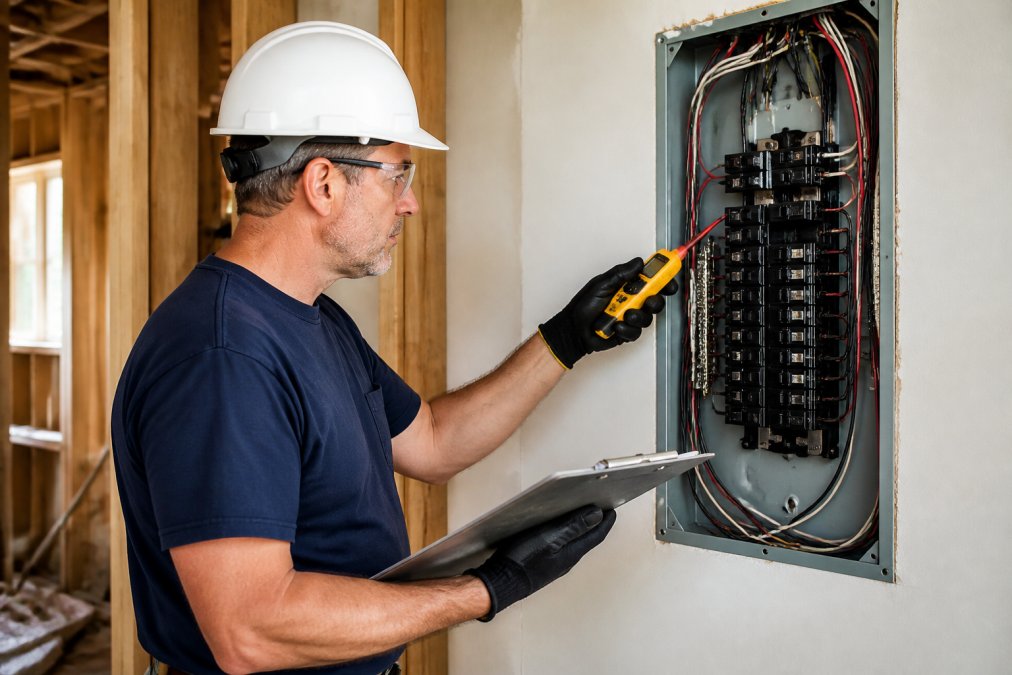
Before drywall goes up, an inspector verifies box fill, cable stapling, hole drilling distance from framing edges, grounding continuity, panel mounting height, GFCI protection on bathroom and kitchen circuits, and AFCI breakers in the required rooms.
A common mistake is running cable through studs too close to the edge without a nail plate. It looks fine until someone hangs a picture and drives a screw through a live conductor.
Final Inspection and the Post-Construction Audit
The final inspection confirms devices work, GFCIs trip under test, AFCIs reset correctly, and the panel is labeled. A post-construction audit goes further: a documented walkthrough that photographs the panel, records breaker assignments, and notes any circuit near capacity.
| Audit Item | What to Check | Why It Matters |
|---|---|---|
| Panel labeling | Every breaker named by room | Faster future service calls |
| GFCI/AFCI test | Trip and reset each device | Confirms shock and fire protection |
| Torque check | Panel lugs at spec | Loose connections cause arcs |
| Load review | Circuit capacity vs. actual draw | Prevents overloaded circuits |
| Surge protection | Whole-home device installed | Protects electronics and appliances |
Hand that table to your electrician and ask for each line to be confirmed in writing.
Hiring a Licensed Electrician for New Construction
Hiring a licensed electrician for new construction determines whether the rest of this article matters. A licensed, insured electrician carries the training, permits, and liability coverage an unlicensed worker does not.
What to Verify Before You Sign
Ask for the license number and verify it with the state licensing board directly. Request a certificate of insurance showing current general liability and workers' compensation coverage. A legitimate contractor hands these over without hesitation.
Curtis Capra Electrician holds license LIC#57632B and has over 25 years of industry experience, including heat pump and standby generator installations that require careful load planning. The team works closely with licensed plumbers for integrated projects, keeping schedules aligned when HVAC and electrical rough-ins overlap.
Common Electrical Hazards on Construction Sites
Construction site electrical hazards fall into recurring categories: damaged power cords, overloaded circuits, missing GFCI protection, and contact with overhead power lines. Knowing the mechanism behind each failure, and the control that prevents it, is what makes a guide useful.
Damaged Cords and the Inspection Routine That Catches Them
Frayed wires and cracked insulation are the most common finds on any active job site. A cord run over by a truck, pinched in a door frame, or dragged across concrete may still carry current while exposing a worker to shock: the outer jacket abrades, the inner insulation follows, and the next person to grab the cord becomes the path to ground.
The control is a documented daily inspection. Before each shift, run the cord end to end, flex it, and look for flattened spots, exposed copper, missing strain relief, and a snapped-off ground pin. Any cord that fails gets tagged out of service immediately. The Occupational Safety and Health Administration (OSHA) treats damaged cord sets as a serious violation under its electrical safety standards.
Overloaded Circuits and the Math Behind Them
Overloading is rarely a single dramatic event. It's a slow accumulation: a circular saw, a compressor, and a battery charger sharing one 15-amp temporary circuit through daisy-chained power strips. Each device draws less than the breaker rating alone, but the combined continuous load pushes the conductor past its ampacity, and heat builds at the weakest connection point.
The practical control is to calculate the load before plugging in. A 15-amp circuit supports roughly 1,800 watts, and continuous loads should stay under 80 percent of that, or about 1,440 watts (osha.gov). A typical circular saw pulls 1,200 to 1,500 watts on its own, so one saw can consume most of a 15-amp circuit. Run high-draw tools on dedicated circuits, and never daisy-chain power strips on a job site.
Missing GFCI Protection on Temporary Power
Temporary power on a construction site requires ground fault protection because wet concrete, metal framing, and standing water turn a minor insulation fault into a lethal shock path. A GFCI interrupts the circuit when it senses a current imbalance of roughly 5 milliamps, fast enough to prevent ventricular fibrillation in most adults (peer-reviewed research).
The failure mode to watch for is a GFCI that's been bypassed because it kept tripping. A tripping GFCI is doing its job; the correct response is to find the fault, not to defeat the device. Portable GFCI pigtails and GFCI-equipped spider boxes are the standard solution for temporary power distribution.
Overhead Power Lines and Clearance Distances
Overhead power lines cause some of the most serious job-site injuries because the voltage is high enough that contact doesn't require touching the line. Ladders, scaffolding, long conduit, and even a raised dump bed can arc to an energized line across an air gap.
OSHA requires specific minimum clearance distances based on line voltage. For lines up to 50 kilovolts, the minimum approach distance for equipment is 10 feet. That distance increases with voltage: 15 feet for lines up to 175 kV, and 20 feet for lines up to 350 kV. Treat every line as energized, and call the utility before any work that brings equipment or personnel within those distances. Many utilities will de-energize or sleeve lines for a scheduled project at no cost to the contractor.
Connector and Termination Failures
Connector safety matters because it's where most hidden failures start. A loose twist-on connector or backstabbed outlet creates resistance at the termination point, and resistance under load creates heat. Over months, that heat oxidizes the conductor, raises resistance further, and eventually produces the arc that starts a fire.
The durable fix is a pigtail connection with properly torqued terminals. A pigtail splices the incoming and outgoing conductors together with a short lead to the device, so the device itself isn't carrying the full circuit current through a push-in connection. Torque matters too: manufacturers publish torque specs for breaker and receptacle terminals, and a screw that's snug by feel is often below spec.
Safe Work Practices That Tie It Together
The controls above only work inside a culture of safe work practices. Lock out the panel before working on a circuit, verify zero energy with a tester rather than assuming, use insulated tools rated for the voltage present, wear appropriate PPE including arc-rated clothing where required, and never work alone on an energized system. A qualified person, as OSHA defines the term, is trained to recognize and avoid electrical hazards; anyone who hasn't been trained to that standard shouldn't be opening a panel.
Smart Home and EV Charging Safety in New Builds
Smart home devices and EV chargers are the two additions that most often push a new build past its original electrical design. Planning for both during rough-in costs a fraction of retrofitting later, and their safety decisions differ from traditional wiring in ways that matter.
Smart Home Integration: The Safety Issues Nobody Warns You About
The safety problem with smart home devices isn't the devices themselves, but the power supply quality and circuit architecture they sit on.
Smart switches, hubs, and controllers contain sensitive electronics that expect stable voltage within a narrow band. When a smart switch shares a circuit with a motor load such as a garage door opener, HVAC blower, or sump pump, the voltage sag on startup can cause nuisance resets, dropped connections, and premature failure of the device's internal power supply. Give smart devices their own circuit where practical, or at minimum keep them off circuits serving large motor loads.
A second issue is neutral wire requirements. Many smart switches need a neutral conductor at the switch box to power their radios, and older wiring methods sometimes switch the hot leg without one. In new construction this is a rough-in decision: run neutrals to every switch box, even where a traditional switch wouldn't need one. It costs almost nothing during rough-in and saves a wall-opening repair later.
A third issue is surge protection. Smart home electronics are more sensitive to transient voltage spikes than the resistive loads traditional homes were wired for. A whole-home surge protective device at the panel, supplemented by point-of-use protection at sensitive electronics, is standard: the panel device handles large surges from utility switching or nearby lightning, while point-of-use devices handle smaller spikes originating inside the home.
EV Charging Station Safety: Load Math and Continuous-Load Rules
EV charging is where new-build electrical planning most often falls short, because a charger is a continuous load running for hours at high amperage. The National Electrical Code treats EV charging as a continuous load, so the circuit must be sized at 125 percent of the charger's rated current. A 40-amp charger therefore needs a 50-amp circuit, not a 40-amp one.
The practical implications for a new build are concrete:
- Dedicated circuit. An EV charger should never share a circuit with anything else. The continuous draw leaves no headroom for other loads.
- Conductor sizing. A 48-amp charger on a 60-amp circuit requires conductors rated for that ampacity at the expected ambient temperature, which often means 6 AWG copper rather than the 8 AWG some installers reach for.
- GFCI protection. The code requires ground fault protection for EV charging circuits. Some chargers include it onboard; others rely on a GFCI breaker. Either way, the protection has to be present and functional.
- Torque and terminations. A charger running for six hours at 48 amps stresses every connection in the path. Manufacturer torque specs on breaker and terminal lugs aren't optional, and a torque screwdriver is the correct tool.
Panel Capacity Planning for Both Loads
A panel sized only for today's loads will be full the moment an EV charger and a heat pump get added. The rough-in question is whether the service and panel have enough capacity for the loads the homeowner is likely to add over the next decade.
A common approach is a panel with spare breaker spaces and a service rating that leaves headroom above the calculated load. A load calculation performed to code, rather than a rule-of-thumb guess, tells you whether a 200-amp service is sufficient or whether the build should go higher. For homes with an EV charger, a heat pump, an electric range, and a tankless water heater, the calculated load can approach or exceed 200 amps, and planning for that during rough-in avoids a service upgrade later.
The Handover Checklist for Smart and EV Circuits
Preventative maintenance starts at day one, and the handover is where it gets documented. Before the homeowner takes possession, record and provide in writing:
- The EV circuit's breaker size, conductor size, and charger amperage setting
- Which circuits serve smart home hubs and controllers, and whether they're on dedicated circuits
- The location and rating of the whole-home surge protective device
- The date of the last panel torque check and the torque values used
- A schedule for the first panel inspection, typically before adding a second high-draw appliance
That documentation turns a future service call into a five-minute lookup and gives any future electrician a baseline for the system.
Frequently Asked Questions
What are the most critical electrical safety standards for new residential construction?
The NEC sets the baseline: GFCI protection in kitchens, bathrooms, garages, and outdoors; AFCI protection on most 120-volt branch circuits; proper grounding and bonding; and correct box fill and conductor sizing. Local amendments can be stricter, so confirm with your local building department. A licensed electrician pulls the permit, schedules rough-in and final inspections, and documents code compliance so the certificate of occupancy is not delayed.
How do I ensure my new construction electrical work meets NEC requirements?
Hire a licensed electrician who pulls the permit in their own name and builds inspection milestones into the schedule. Ask for the rough-in inspection before drywall goes up, and keep the approved inspection card on site. Request the panel schedule and circuit directory at closeout. If anything changes mid-build, such as adding a heat pump or EV charger, update the load calculation before the walls close.
What are the common electrical hazards to watch for during the framing stage?
Framing is when temporary wiring, damaged cords, and overloaded circuits cause the most problems. Watch for frayed or taped power cords, daisy-chained extension cords, missing GFCI protection on temporary power, and extension cords run through standing water. Keep temporary lighting and tools on separate circuits where possible, and inspect cords daily. Any overhead power line within reach of ladders or scaffolding needs to be treated as energized.
Why is professional electrical inspection vital for new construction?
Inspections catch problems while walls are still open, when fixes cost the least. A residential electrical inspection verifies grounding, GFCI and AFCI placement, panel capacity, and wiring integrity against the NEC and local code. Skipping or rushing the rough-in stage typically means opening finished walls later. Inspections also protect your insurance coverage and give you documentation if you sell the property.
What role do AFCI and GFCI breakers play in new home safety?
GFCI breakers and receptacles cut power when they detect a ground fault, which is the shock risk near water and outdoors. AFCI breakers detect the arcing signature behind many electrical fires, which is common in bedrooms and living areas where damaged wiring hides inside walls. New homes typically need both, and the required locations have expanded in recent NEC editions. Test them monthly using the test button.
Can I add smart home devices and an EV charger to a new build without overloading the panel?
Yes, if the load calculation accounts for them before the service is sized. Smart switches, cameras, and hubs add small continuous loads, but an EV charger can draw 40 to 48 amps on its own. Ask your electrician to size the panel and service with those loads in mind, and consider a dedicated circuit for the charger. Retrofitting later often means a service upgrade.